Calling and the Beginning of Chaplaincy Service
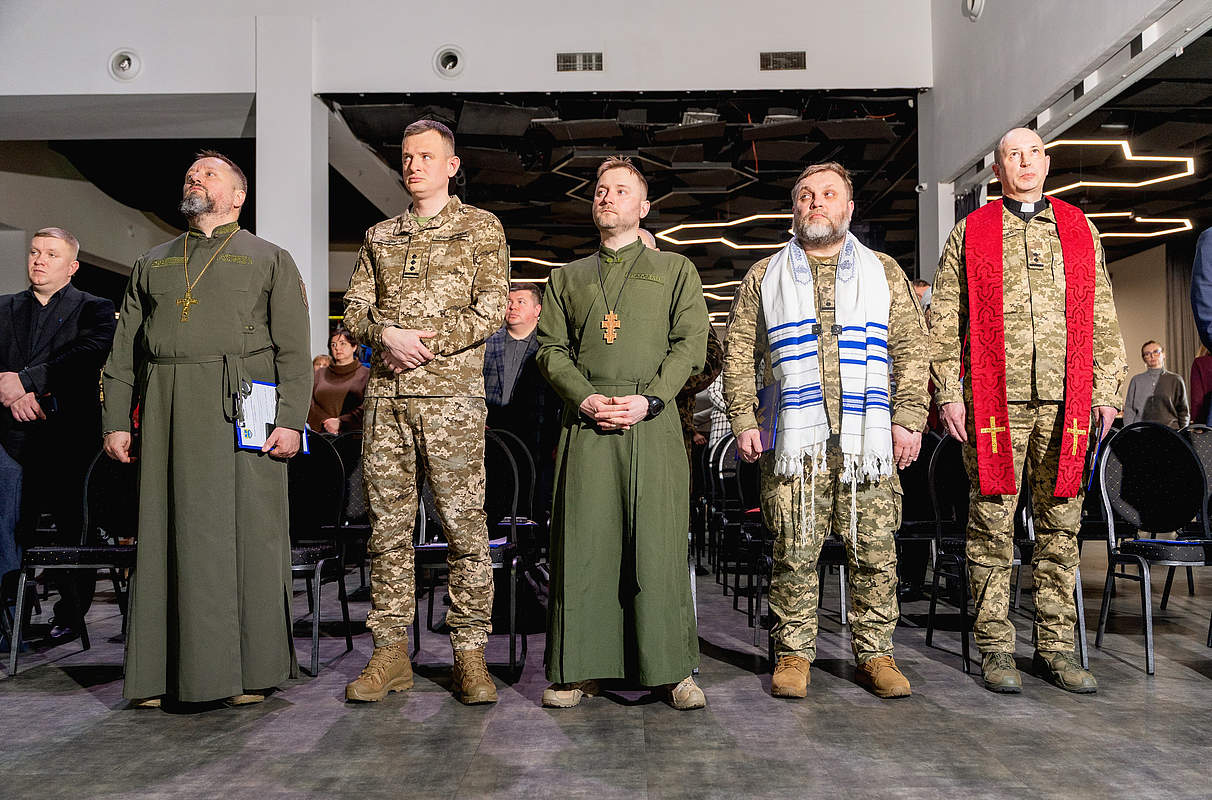
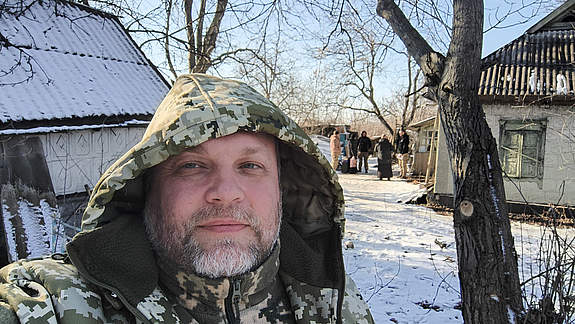
My calling to serve as a chaplain began with the question: whom would I be willing to serve? The war had already been ongoing from 2014 to 2022, and during that period, I provided spiritual accompaniment to soldiers in a specific unit. Prior to this, I had also completed military training. When Russia launched its full-scale invasion of Ukraine in 2022, I was asked if I would be willing to pray for the soldiers and provide them with spiritual support as a chaplain. Thus, my ministry emerged from a genuine, pre-existing relationship built on trust.
My first experience at the front was in Kyiv. As the city became increasingly deserted and the fighting raged, I shifted my focus away from civilian projects and toward providing spiritual support to the soldiers—chaplaincy became my primary mission.
Chaplaincy Service
Today, the nature of service directly at the front differs significantly from service in the rear. We go wherever we are needed. There is currently a very high demand for chaplains. My first priority is the well-being of the team—ensuring shelter, food, and safety—and only then can the spiritual ministry take place. Most decisions must be made quickly and spontaneously. I make sure that our chaplaincy work is not reduced to merely providing material aid; it remains, first and foremost, a spiritual ministry.
We encounter a wide variety of soldiers whose lives have been scarred by the war—survivors of combat, individuals who have lost comrades-in-arms. For many, war has become their daily reality and their "job." To them, a weapon is simply a tool of their trade. The war forces some to push against the limits of their own moral boundaries—or even to cross them—in order to fulfill their duty. Many carry deep psychological trauma. For me, the most important thing is to listen to what God wants to say to the specific individual I am working with at that moment. My task is to help that person become fully human again—for human beings were not created for war, but for communion with God. I want to help soldiers find inner peace and once again sense God’s presence. Each person requires a different approach: with some, I pray; with others, I simply listen—sometimes the best form of support is just to be present in silence. I constantly seek God’s guidance to understand what He wishes to convey to that person through me.
Feelings of Guilt and God’s Forgiveness
Following the loss of loved ones, the death of comrades, the breakdown of their own families, the experience of moral dilemmas, or the failure to save a wounded person in time, many soldiers ask themselves: “Does God still love me after everything that has happened in this war?” In such moments, my role is to help them bring this burden to Christ, to lay their guilt at the foot of the cross on Golgotha, and to accept God’s forgiveness.
Many families expect their loved ones to return from war exactly as they were before it began. Yet, war changes people. Some return emotionally traumatized; others bear physical or psychological wounds. Some have consciously suppressed or shut down certain aspects of their own nature because the war demanded behaviors that became essential reflexes for survival. Many are haunted by painful memories that are difficult to cope with on their own.
To me, the greatest miracle is witnessing soldiers find their place in life once again: they start families, launch their own businesses, and pursue their dreams. One soldier, in particular, has stayed in my memory; after intense combat, she sent me a photograph of her family and her firstborn child. Stories like this remind me that God is capable of bringing about restoration, even after the most harrowing experiences.
If God exists, why does He allow war?
There is no simple answer to the question, "If God exists, why does He allow war?"—if there were, it would be very easy for people to come to faith. People also die from illnesses, natural disasters, and other life circumstances—not just in war. It is important to understand that war was not created by God; rather, it is a manifestation of evil—a war waged by the devil against humanity.
At the same time, it is human beings who initiate wars: politicians make the decision to start them, soldiers carry them out, and peacemakers strive to bring them to an end. War is not God’s plan for humanity; it is something that human beings inflict upon one another.
The Foundation of Chaplaincy
Spiritual preparation is an essential component of chaplaincy. Prayer is necessary before a deployment, during one’s service, and especially upon returning. After every return from the field, time is required for spiritual renewal, a fresh encounter with God, and inner replenishment.
When asked how the war has changed my faith, I respond as follows: If one’s faith collapses—or only comes into existence—after the first missile strikes, one must ask whether that faith was ever genuine to begin with. My relationship with God has become even closer and more trusting during the war.
My key verse is: "Rejoice always." I consciously seek a reason for joy, even in the midst of war—most often, the opportunity to serve another person. God created us in such a way that by serving our neighbor—by looking away from ourselves—we are restored and gain new strength.
Human endurance and resilience have their limits. When a person walks with God, His power sustains them precisely where their own strength reaches its end.
In war, people often experience loneliness. This can become a trap, but it can also lead to a deeper encounter with God—if one embraces the solitude that God Himself knows, and discovers that He, too, seeks this closeness. Loneliness is one of the greatest trials for the chaplain as well; thoughts such as "I failed to help" may arise. Those who rely solely on their own strength will not remain in this service for long—a chaplain must remember that while human strength is limited, God’s power is inexhaustible.
The next level of God’s love—the place to which Christ desires to lead us—is the love of one’s enemies. No human being can achieve this through their own power; it is a supernatural work of God within the human heart. The more time a chaplain spends with God, the better protected he is against cynicism, emotional burnout, and the hardening of his heart. After every deployment, intentional time for spiritual renewal is essential—it is not enough to simply attend to practical matters.
The foundation of Christianity is forgiveness, through which the deepest inner restoration of a human being takes place. A central task of the chaplain is to help soldiers forgive themselves and others, and to accept God’s forgiveness.
The need for military chaplains today is immense: new requests for deployments arrive every month, yet there remains a shortage of chaplains.
What churches should know about chaplaincy and the reality of war
The church must be prepared to embrace the reality of suffering and must not turn away from the pain of those who have lived through war. Every person returning from the front line requires pastoral care, spiritual support, and restoration. It is important for every church to have at least one chaplain who is well-versed in the nature of traumatic war experiences. A chaplain should not be an external entity, but rather an integral part of the church—a servant who helps the congregation respond to the needs of individuals in the aftermath of war.
Many veterans do not yet attend church, as the war continues and they still feel a sense of responsibility toward their comrades. Instead, many dedicate themselves to providing material support for soldiers at the front, pouring all their time into this mission—often without any breaks or periods of rest. Every veteran carries their own unique story and personal traumas. Churches should therefore consider how to incorporate programs for the reintegration and adjustment of veterans into their ministry. They must be prepared to walk alongside these individuals for the long term—much like a father caring for his child—navigating difficult times and conflicts together, and helping them find their way back to civilian life. For some veterans with severe physical injuries—such as those resulting from amputations—the greatest support is often simply the opportunity to be among others and to feel accepted.
A Message to Young People
To young people, I would like to say this: Pray that there will be no war. War is not romantic, nor is it heroic; rather, it is hard work, pain, and responsibility. In war, a weapon is merely a tool for fulfilling one’s duties.
One should not be disappointed if prayers go unanswered. The most important thing is to live for Christ, regardless of whether it is a time of peace or war. One must not shirk one’s own responsibility by relying solely on the hope that war will never occur—the Bible itself states that there will be wars until Jesus returns.
Each person must discern from God where their place is. God calls individuals to service in various ways—as a doctor, as an educator of the next generation, as a defender, or in some other capacity. The most important thing is to recognize the place God has intended for you and to remain within it.
It is dangerous to believe that preparation for crises is unnecessary—societies that ignored the threat of war have often fallen victim to aggression and totalitarian regimes. This was, to some extent, the case in Ukraine before the Russian invasion.
War destroys human morale; yet, for this very reason, it is all the more important to seek God—to live with Him, in times of both peace and war—to remain faithful to one’s own calling, and to prepare one’s heart for the encounter with the Lord.